Governance. Trust. Human Oversight.
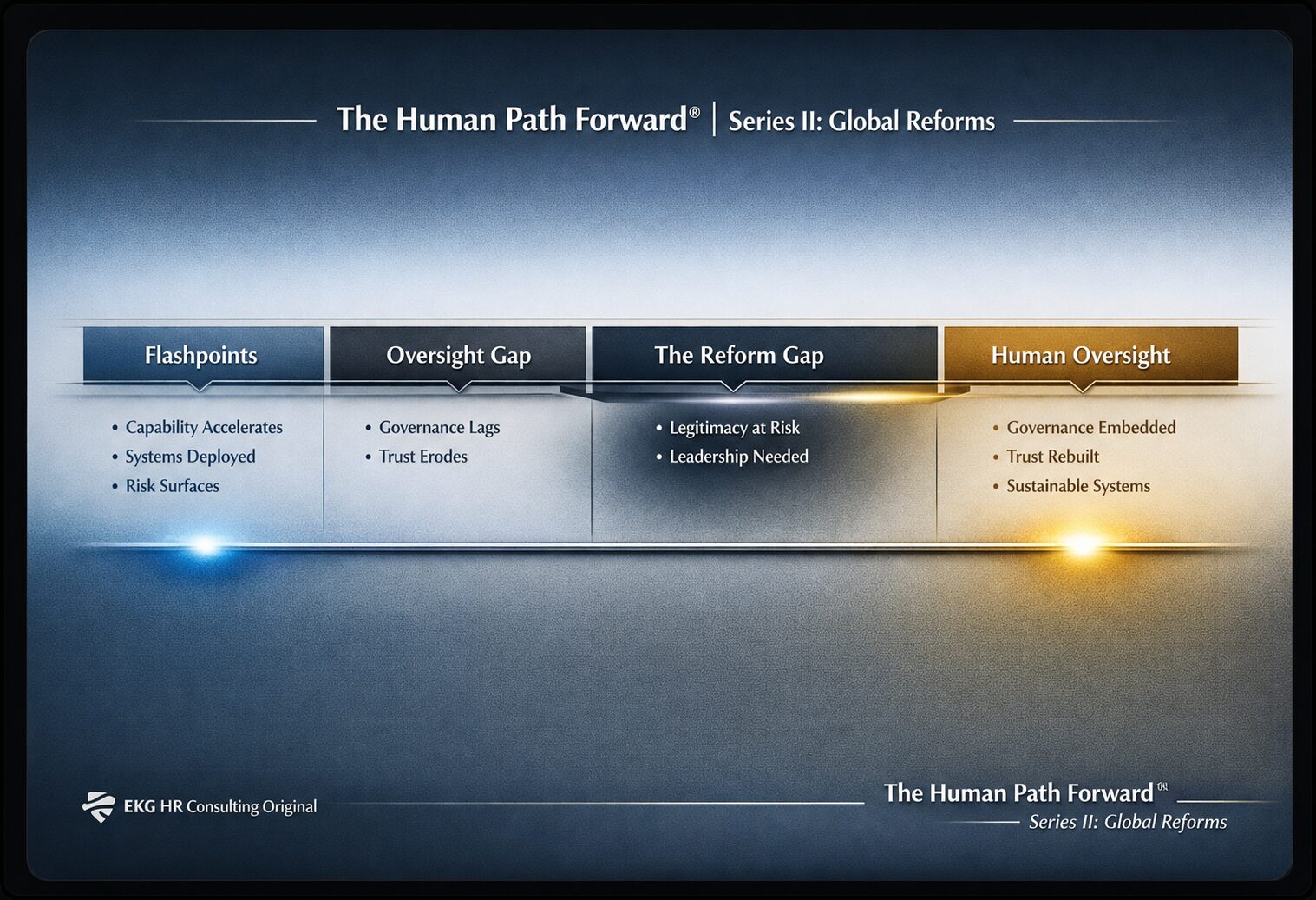
Institutions are entering a period where technological capability is advancing faster than the systems designed to govern it.
But this isn’t theoretical. Organizations are already seeing automation reshape decisions, risk, labor, and legitimacy in the present tense, often faster than policy, oversight, and leadership can adapt.
Series I (AI Flashpoints) surfaced fracture points created when automation, AI, and algorithmic decision-making outpace institutional readiness. The Human Leader explores how leaders must respond internally: ethically, psychologically, and relationally inside that disruption.
Series II examines what must follow. It focuses on the structural reforms required to preserve legitimacy, rebuild trust, and embed human oversight before regulation, litigation, or collapse forces reaction.
This is not speculative futurism. It is an examination of governance, work, and accountability at the institutional level while there is still room to act deliberately.
Parts I–VIII are available now. Series II concludes with Part VIII.
The Human Leader explores how leaders respond internally: ethically, psychologically, and relationally inside the same disruption Series II addresses institutionally.
Across eight parts, Global Reforms moved from institutional readiness into the operating realities that determine whether reform can actually hold. The series ultimately concentrated on the structures, authority, feedback, and human capacity required to govern change once it leaves policy and enters everyday organizational life.
The themes below reflect the work the completed series actually developed rather than an earlier map of topics that might have been explored.
Institutional Readiness
Whether an organization can realistically carry the decisions it makes, including the operating capacity, infrastructure, knowledge, and support required after change is approved.
Human Oversight & Decision Authority
How ownership, decision rights, escalation pathways, and real authority determine whether human oversight can govern systems and decisions rather than merely surround them.
Accountability & Intervention
Whether institutions retain the authority and willingness to interrupt drift, correct weakened operating conditions, and keep responsibility connected to the people empowered to act.
Institutional Trust
How trust is shaped by visible ownership, meaningful recourse, credible correction, and whether people can see that concerns, failures, and unintended consequences can actually change institutional behavior.
Learning & Corrective Capacity
How organizations preserve institutional memory, learn from intervention, carry lessons forward, and strengthen the operating system instead of repeatedly solving the same problem through individual effort.
Capacity, Change & Priority Tradeoffs
How accumulated change, constrained capacity, and unresolved priorities move strain into managers and employees, and how leadership choices become visible through what the institution ultimately protects.
EKG HR Consulting works with boards, executive teams, and institutional leaders navigating reform readiness. We help translate governance pressures into operational, human-centered oversight models.
This advisory work is designed for organizations that want to act deliberately, rather than react defensively, as reform pressures intensify.
For organizations navigating governance, workforce trust, and accountability in complex systems.
The Human Path Forward® is an original thought leadership series authored by Jerrell Rogers and published by EKG HR Consulting LLC.
Rights & Intellectual Property (click to expand)
© 2026 EKG HR Consulting LLC. All rights reserved.
All original written content, analytical frameworks, governance models, and editorial materials associated with
The Human Path Forward®,
including Series I and Series II, are proprietary intellectual property of EKG HR Consulting LLC and may not be reproduced, distributed, adapted, or republished without prior written consent.
The Human Path Forward®
is a registered trademark of EKG HR Consulting LLC.
Redeploy, Don’t Replace™
is an unregistered mark used in commerce.
Limited quotation for commentary or educational discussion is permitted with clear attribution. Commercial reuse, training delivery, or derivative works are prohibited without authorization.