
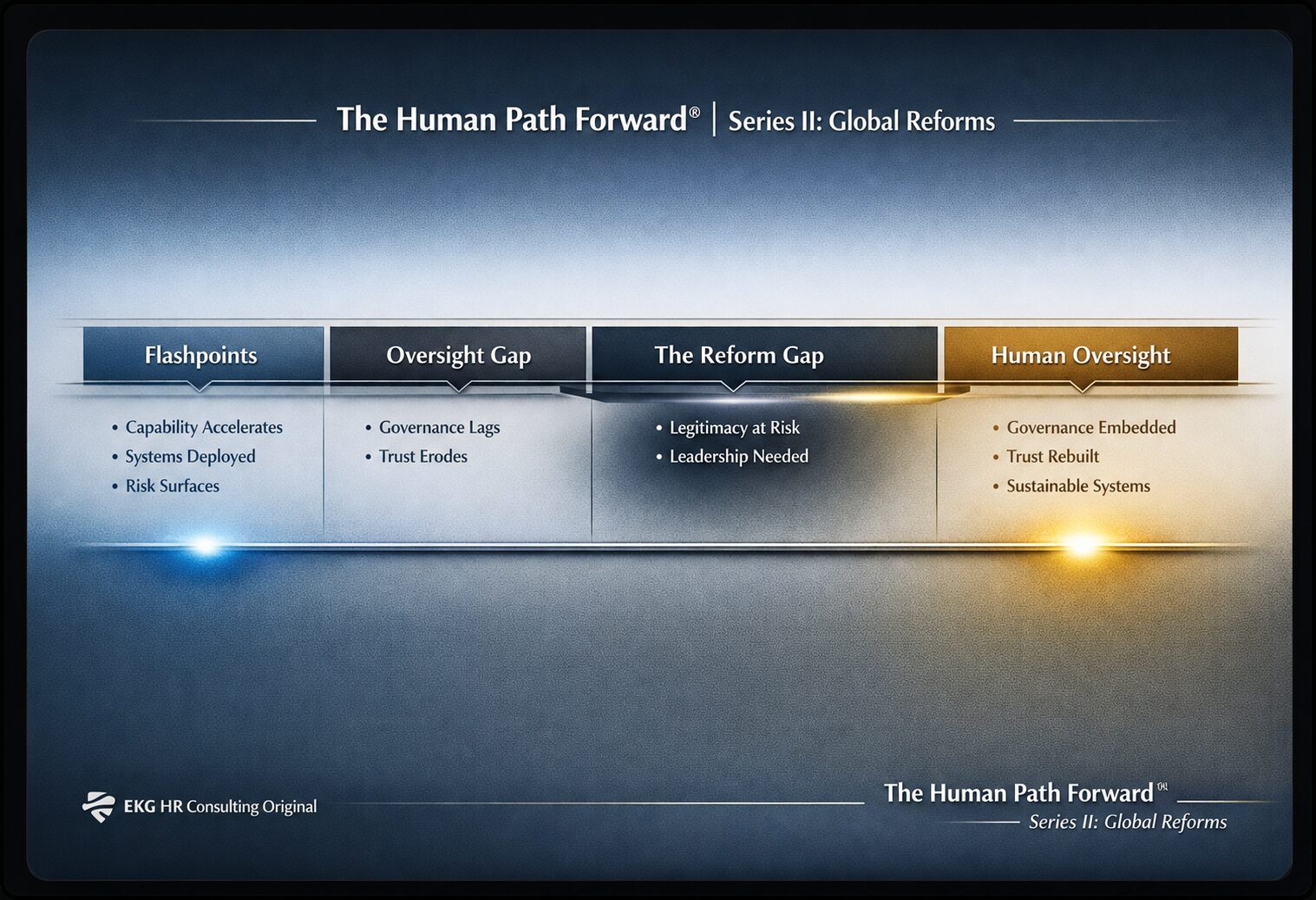
Executive Abstract
- Organizations struggle when one part of the institution changes faster than the surrounding operating environment can adapt.
- Growth, reorganization, financial pressure, and technology can each create conditions where institutional change outpaces institutional readiness.
- The Reform Gap is the distance between what an organization decides, adopts, removes, or expands and what the institution is actually prepared to carry.
- The existence of that gap does not necessarily mean the underlying decision was wrong; difficult choices often emerge from real operational constraints.
- Human consequences such as workload strain, uncertainty, knowledge loss, turnover, and managerial pressure often reveal the gap before formal measures do.
- Durable reform depends on whether organizations continue examining what their decisions create elsewhere in the operating system after implementation.
Part I
The Reform Moment
Organizations make decisions within specific circumstances. A business expands because opportunity exists. A structure changes because the existing model no longer fits the direction of the organization. Headcount is reduced because financial conditions no longer support the current workforce. New technology is introduced because existing systems cannot provide the speed, consistency, or scale now required.
Each decision may be reasonable on its own. The difficulty often emerges in what the rest of the organization must absorb afterward.
Growth can expose weaknesses in functions that previously operated effectively. An organization may already have recruiters, established processes, and sufficient recruiting resources yet discover that its support model no longer reflects where the business is growing. Recruiters supporting distant markets may understand the hiring process while lacking sufficient familiarity with the operation, local labor conditions, or the leaders they serve.
Under those conditions, the organization possesses recruiting capacity without having that capacity positioned where it can be most effective. Positions remain open longer. Hiring managers experience weaker alignment. Existing employees carry vacancies while growth expectations continue. Eventually, staffing delays begin constraining the expansion those hires were intended to support.
The answer is not always additional resources. Sometimes existing capability has simply failed to evolve with the operating environment. Positioning expertise closer to the business, strengthening understanding of the work, and building direct relationships with leaders can change performance without fundamentally changing the function itself.
Reorganization creates a similar challenge because an organization can remove a position much faster than the responsibilities attached to it disappear. Those responsibilities move to managers, adjacent functions, or remain unresolved until the absence becomes visible through slower decisions, reduced responsiveness, or unmet operational needs.
The strain becomes greater when that work moves to leaders already carrying broader priorities. Strategic partnership thins, issues that were previously handled without escalation begin moving upward, and operational leaders may understand why the structure changed while still becoming frustrated because their needs did not change with it.
Leadership may recognize the consequences and remain unable to reverse course. Financial assumptions may depend upon the new structure, or broader priorities may limit the ability to restore eliminated capacity. The resulting strain does not necessarily mean the original decision lacked logic. It may instead reveal how quickly organizations can alter structure compared with the responsibilities, relationships, and dependencies surrounding it.
Operating Conditions
When One Part of the Organization Moves Faster Than the Rest
This pattern becomes more pronounced when change is driven by sustained financial pressure.
Organizations sometimes reach a point where workforce reductions are not discretionary. Revenue declines, operating costs exceed available resources, or business conditions make existing staffing levels impossible to maintain. Leaders may understand that reducing headcount will create strain while recognizing that the institution cannot continue financially without doing so.
Financial necessity does not remove the operational consequences.
Work attached to eliminated positions remains distributed throughout the organization. Responsibilities move to employees with existing workloads. Managers reprioritize. Teams determine what can be delayed, what must continue, and what can be performed differently. For a time, those adjustments may prevent an obvious breakdown.
Repeated reductions create a different operating condition. Responsibilities once distributed across several positions become concentrated among fewer people. Managers assume work previously performed by dedicated roles. Employees take on unfamiliar responsibilities because no one else remains available to perform them.
Workforce reductions also change the institution's knowledge base. Employees with ten, fifteen, or twenty years of experience carry judgment that cannot be transferred completely through documentation. They know why exceptions exist, which relationships make processes function, how internal systems evolved, where recurring problems emerge, and how to respond when formal procedures no longer fit the circumstances.
The exposure becomes greater when organizations rely upon internally developed systems or processes whose operation depends heavily upon the people who created or maintained them. The organization may retain the system after those employees leave while losing much of the practical knowledge required to operate or modify it effectively.
Repeated reductions also influence how employees interpret their future within the institution. People can understand the financial reasons behind workforce decisions while carrying increased workload, concern for departed colleagues, and uncertainty about whether their own positions will eventually be affected.
Over time, some employees choose not to wait. Voluntary turnover follows involuntary turnover, and when headcount restrictions prevent replacement hiring, the remaining work is redistributed again across an already smaller workforce.
The institution becomes smaller even as many of its obligations remain unchanged.
These human consequences become operational consequences. Managerial attention narrows. Decisions take longer. Institutional memory weakens. Workarounds increase. Employees who remain committed to the organization begin evaluating how much uncertainty and additional responsibility they can continue carrying.
Because work is still being completed, declining capacity can remain difficult to recognize. Customers are served, deadlines are met, and teams continue finding ways to operate, even while performance depends increasingly upon fewer people, narrower sources of knowledge, and less margin for whatever change arrives next.
The condition develops not from one decision, but when several rational or necessary decisions accumulate faster than the institution can absorb their consequences.
Synthesis
The Reform Gap
The conditions described above point to a broader institutional problem than any single form of change.
Growth changes staffing needs before support functions have evolved. Reorganization changes structures while responsibilities remain distributed according to the previous model. Financial contraction reduces labor while much of the work and institutional dependency remains. Technology expands capability while governance, accountability, and human judgment continue adapting around it.
The Reform Gap exists within the distance between those changes and the institution's readiness to carry their consequences.
This gap is not defined by the absence of planning. Organizations may have strategic plans, financial models, workforce projections, policies, and leadership structures intended to guide transition. The difficulty is that decisions rarely remain contained within the boundaries established for them.
A staffing decision affects workload. Workload affects responsiveness. Reduced capacity changes which priorities receive attention. Departing employees take knowledge with them. Workarounds become part of normal operations. A decision made for one legitimate reason begins producing secondary effects elsewhere in the institution.
Those effects are not always predictable, nor do they mean every difficult decision should have been avoided. The more useful distinction is whether leaders continue evaluating what the decision has created after implementation.
Institutional readiness therefore involves more than successfully announcing or completing a change. It includes whether managers have enough capacity to translate it into daily operations, whether employees understand changing expectations, whether knowledge remains available where it is needed, whether responsibilities remain clear, and whether leadership is receiving an accurate picture of the organization under the new conditions.
Technology creates the same challenge in another form. Systems may increase speed or analytical capability while changing how decisions are produced and who meaningfully owns them. When responsibility is distributed across technology, vendors, policy, managers, and functional leaders, sophisticated capability can coexist with limited ability to explain, challenge, or correct the outcomes it produces.
The governance problem therefore remains central to the Reform Gap, but it belongs to a broader institutional pattern. Capability can advance through technology, growth, restructuring, or necessity. In each case, institutional readiness depends upon whether the organization surrounding that change has evolved sufficiently to support it.
Human Consequence
People Experience the Gap Before Institutions Measure It
Organizations often recognize operational strain after it becomes visible through formal indicators. Turnover rises. Vacancies remain open. Deadlines slip. Employee engagement declines. Managers escalate recurring problems. Compliance weaknesses emerge. Performance data eventually confirms that something in the operating environment has changed.
People frequently experience those conditions much earlier.
Employees notice when responsibilities previously carried by several people begin concentrating among fewer colleagues. Managers recognize when they are spending more time resolving issues once addressed elsewhere. Teams discover where institutional knowledge was concentrated only after the person carrying it has departed. Hiring managers experience inadequate recruiting support before workforce projections show the full effect of unfilled positions.
These experiences matter because organizational performance is not separate from the people producing it.
An employee can understand why a workforce reduction was financially necessary and still struggle with the additional work that follows. A manager can support a reorganization while becoming frustrated by the reduction in resources available to serve the department. Employees can remain committed to an institution while becoming increasingly uncertain about whether they will still have a place within it after another round of change.
Those responses are often described through morale, engagement, or resistance. Each can capture part of what is happening while leaving the operating conditions underneath the response insufficiently examined.
Frustration may reflect responsibilities that have expanded beyond available capacity. Anxiety may reflect repeated decisions that have made future employment increasingly difficult to predict. Reduced engagement may follow months of additional work, loss of colleagues, or diminished confidence that current conditions are temporary. Turnover may represent employees deciding how much uncertainty or workload they are prepared to continue carrying.
One of the more difficult realities of organizational life is that leaders and employees can understand the same decision while experiencing it very differently. Leaders may see the financial constraint requiring action. Employees experience what the action changes in their daily work. Managers may understand both perspectives while having limited ability to reconcile them because they are operating under the same constraints.
Human consequences therefore provide important information about institutional readiness. They reveal where organizational decisions are producing strain before that strain becomes visible through formal measures.
Recognizing those consequences does not require organizations to reverse every difficult decision or eliminate every source of discomfort. It requires enough awareness to distinguish temporary adjustment from a deeper mismatch between what the organization expects and what its people and operating systems can continue sustaining.
By the time the institution measures that mismatch, people may have been living inside it for months.
Accountability
What Reform Requires
Reform begins with a more complete understanding of what organizational decisions require after they have been made.
A restructuring cannot be evaluated only by whether the new organizational chart was implemented. Leaders also need to understand where responsibilities moved, whether managers have sufficient capacity to absorb them, and whether important relationships or expertise weakened during the transition.
A workforce reduction cannot be understood solely through positions eliminated or financial savings achieved. The institution also needs to understand which work remains, where it will reside, what knowledge is leaving, and whether the remaining workforce can sustain the resulting demands.
Growth requires the same discipline. Expanding the business without examining whether recruiting, management capacity, systems, and support structures are evolving alongside it can create a condition where organizational ambition exceeds the infrastructure required to achieve it.
Technology adds another layer because capability can increase without creating equally clear ownership of the decisions being produced. Institutions need to understand not only whether systems are working, but who can explain their outcomes, who has authority to intervene, and how human judgment remains connected to decisions carrying meaningful consequences.
Across each condition, reform becomes less about preventing difficult change than about preserving the organization's ability to understand what that change is doing.
That requires leaders to remain close enough to operating reality to recognize when assumptions made during planning no longer reflect what managers and employees are experiencing. Communication must move in both directions, allowing organizational priorities to reach the workforce while operating conditions travel back toward those making decisions. Structures, expectations, resources, or pacing may need adjustment when consequences emerge that were not anticipated at the outset.
Accountability remains central because change frequently crosses functional boundaries. An organization may have competent leaders across HR, finance, operations, technology, and compliance while still lacking clear ownership of the consequences created between them.
Human oversight matters for the same reason. Institutions retain credibility when people possess enough authority, information, and judgment to understand what is happening, identify who owns the resulting conditions, and respond when operating reality begins diverging from intended outcomes.
Institutions do not lose legitimacy when systems fail. They lose legitimacy when no human can credibly claim authorship of outcomes.
Reform becomes durable when that capability remains after the initial decision has passed.
Closing Posture
What Institutions Must Be Prepared to Carry
Organizations will continue making decisions under imperfect conditions. Growth will sometimes occur before support systems are ready. Financial pressure will require difficult choices. Structures will change. Technology will alter how work is performed and decisions are produced. The relevant question is not whether disruption can always be avoided, but whether the organization understands what follows from the decisions it makes.
Every significant change alters the environment in which people work. Responsibilities move, relationships change, knowledge becomes more or less accessible, and managers absorb different demands. Employees interpret what those changes mean for their work and their future. Some effects are temporary. Others remain long after the original decision has disappeared from leadership agendas.
The Reform Gap develops when those consequences accumulate faster than the institution's ability to recognize and respond to them.
Closing that gap does not require perfect foresight. It requires organizations to remain capable of seeing themselves accurately while change is unfolding. Leaders need to understand whether the conditions surrounding a decision remain workable. Managers need enough capacity to translate direction into daily operations. Employees need enough clarity, support, and confidence to continue carrying the work required of them.
The human consequences of change therefore belong inside the assessment of institutional performance rather than outside it. Workload, frustration, uncertainty, trust, knowledge loss, and turnover are not merely reactions occurring alongside organizational change. They can reveal whether the institution remains capable of sustaining what it has asked people to carry.
Organizations rarely experience the Reform Gap because they changed. The gap emerges when the consequences of change extend further through the institution than the decision itself accounted for.
Understanding that difference is where reform begins.
Sources
- Prior Human Path Forward® Series II analysis on governance lag, institutional learning, operating conditions, corrective capacity, and adaptation under pressure
- Cross-sector organizational research concerning workforce restructuring, transformation execution, change saturation, workforce capacity, managerial bandwidth, and institutional knowledge
- Enterprise observations involving workforce growth, operating-model redesign, headcount reduction, recruiting alignment, and the redistribution of responsibilities across functions
- Workforce and leadership observations concerning workload, employee uncertainty, voluntary turnover, trust, decision delays, managerial strain, and the human consequences of organizational change
- Regulatory and policy discourse concerning responsible AI, accountability, human oversight, auditability, organizational control, and the governance of increasingly automated decision systems
- Long-term practitioner observation of organizational transformation, workforce systems, leadership behavior, institutional knowledge, and the gap between planned change and lived operating reality
The Human Path Forward® is an original thought leadership series authored by Jerrell Rogers and published by EKG HR Consulting LLC.
Rights & Intellectual Property (click to expand)
© 2026 EKG HR Consulting LLC. All rights reserved.
All original written content, analytical frameworks, governance models, and editorial materials associated with
The Human Path Forward® (including Series I and Series II) are proprietary intellectual property of
EKG HR Consulting LLC and may not be reproduced, distributed, adapted, or republished without prior written consent.
The Human Path Forward® is a registered trademark of EKG HR Consulting LLC.
Redeploy, Don’t Replace™ is an unregistered mark used in commerce.
Limited quotation for commentary or educational discussion is permitted with clear attribution. Commercial reuse, training delivery, or derivative works are prohibited without authorization.