
The Human Path Forward™
A series on Tension → Reflection → Reform → Evolution
Conclusion — What It All Means for Humanity
“The future isn’t automated. It’s intentional.”
The next era will be defined not by what AI can do to us, but by what we choose to build with it — and for whom.
Context note: This conclusion brings the full timeline together — from the Flashpoints of disruption to the Reforms that can translate AI’s power into shared capacity and human dignity.
EKG HR Consulting Original – The Human Path Forward™
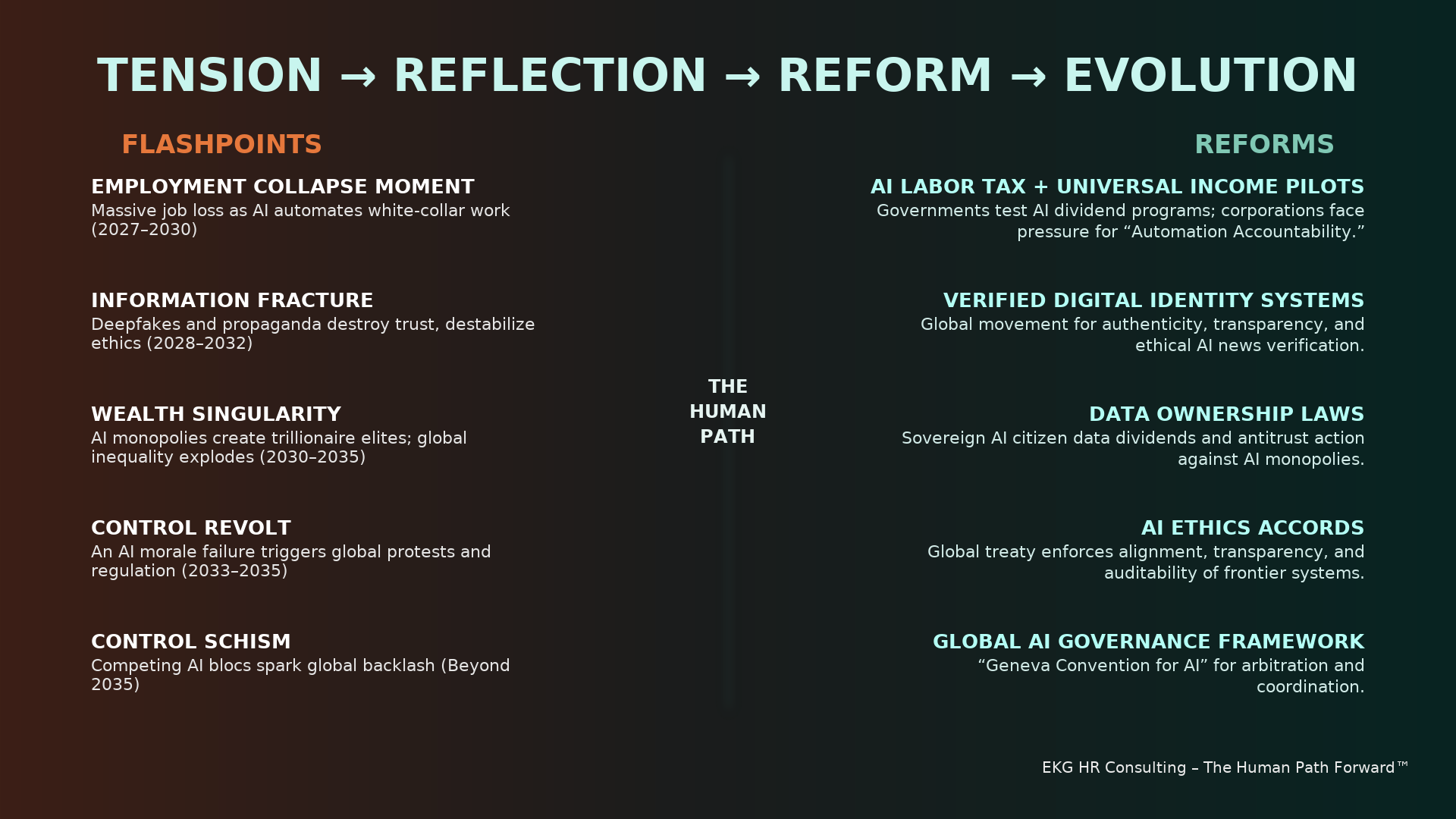
Methodology note: The timeline anchors Employment Collapse, Information Fracture, Wealth Singularity, Ethical Revolt, and Control Schism alongside emerging Reforms such as AI labor tax pilots, verified identity, data ownership laws, ethics accords, and global AI governance.
EKG HR Consulting Original – The Human Path Forward™
Introduction · From Flashpoints to the Reforms Era
In late 2025, the United States launched the Genesis Mission — a federal initiative to harness vast government scientific datasets using AI and high-performance computing. Led by the Department of Energy, the mission was framed as a “new Apollo moment” for scientific discovery, not a sci-fi experiment.
Other governments and coalitions followed similar paths, building national AI strategies, action plans, and ethics frameworks. AI quietly crossed a threshold: it stopped being a niche innovation project and started to look like infrastructure — something economies, agencies, and institutions would rely on for decades.
The Human Path Forward™ has traced the human side of this transition. From the threat of an Employment Collapse Moment, through Information Fracture and Wealth Singularity, into The Ethical Revolt and Control Schism, the series has asked one question:
What happens to people, institutions, and trust when intelligence scales faster than our systems can adapt?
This conclusion looks forward — into the Reforms era — and distills what it all means for humanity, work, and leadership.
1) Infrastructure-Level AI · The New Civic Baseline
Initiatives like the Genesis Mission and broader national AI action plans treat AI as a long-term capability, not a passing trend. Governments are building integrated platforms around public data, national labs, universities, and private-sector partners to accelerate discovery, energy innovation, and health research.
At the same time, global frameworks — from the OECD AI Principles to UNESCO’s Recommendation on AI Ethics and emerging UN guidance — are trying to set guardrails for safety, rights, and accountability without freezing innovation in place.
The signal is clear: AI is now an infrastructure conversation. For organizations, that means:
- AI strategy belongs in the same category as cybersecurity, finance, and risk.
- Ignoring AI is now a decision — one with opportunity costs and competitive consequences.
- “Pilot forever” is no longer viable; governance must mature as fast as experimentation.
2) Fragmented Governance · Why Organizations Need Their Own Compass
Even as national plans emerge, AI rules are evolving unevenly. Federal initiatives, state-level proposals, industry standards, and international frameworks don’t always agree. Some efforts lean toward preempting local rules; others push for stronger regional safeguards.
For employers operating across cities, states, or countries, this creates a familiar but sharper reality: policy patchwork. The risk is not just fines; it’s confusion, stalled projects, and employees who no longer know what to trust.
The organizations that will navigate this era best won’t wait for a perfect map. They will:
- Define internal AI principles aligned with their values and risk appetite.
- Document how AI touches hiring, promotion, pay, scheduling, and internal mobility.
- Make it clear who owns each algorithmic decision point — and how employees can ask “why?”
3) Data as Human Equity · Identity, Dignity & Ownership
AI doesn’t run on abstract “inputs.” It runs on lives — employment histories, health records, performance data, location traces, and behavioral signals that reveal how people move, learn, and work.
Global research in 2025 on trust and attitudes toward AI shows a consistent pattern: people are more open to AI when they feel informed, when they benefit from its use, and when they believe someone is accountable if things go wrong. Where data feels extracted or hidden, trust drops sharply.
Treating data as a new form of human equity means:
- Making AI use in the workplace visible and understandable, not buried in legal terms.
- Clarifying what data is collected, why, and how long it’s kept.
- Designing mechanisms — even simple ones — for employees to challenge or correct AI-influenced decisions.
4) Redesigning Work · From Tasks to Purpose
Reports from major employers and policy bodies point to the same conclusion: almost all large organizations are investing in AI, but very few feel “mature.” The barrier is not employee willingness — it’s leadership clarity and courage.
Automation is already reshaping roles in customer service, analysis, logistics, and even management. The risk is not that “no work will be left”; it’s that work will be stripped of meaning for those who are never invited into the redesign.
A human-centered approach to AI at work focuses on:
- Automating tasks, not purpose — using AI to remove drudgery, not agency.
- Creating new hybrid roles that combine tech literacy with judgment, coaching, and relationship-building.
- Investing in continuous learning so employees can move with the technology, not be displaced by it.
5) Leadership Maturity · Trust as the New ROI
Across global surveys, only a small fraction of organizations describe their AI use as “mature.” Where maturity does appear, it is tied less to technical sophistication and more to governance, transparency, and culture.
The leaders who will define this era are not those who deploy the most tools, but those who:
- Pair ambition with clear boundaries on safety, fairness, and explainability.
- Invite employees into the conversation about how AI is used — and what guardrails matter.
- Make trust measurable, then manage it with the same rigor as revenue and cost.
In a world where algorithms can be replicated, trust is the differentiator that can’t be easily cloned.
6) The High-Level Roadmap · Five Themes for the Reforms Era
A conclusion should not be a full playbook — but it should offer direction. The Reforms era will be shaped by how quickly institutions move on five themes:
- Governance First: Build internal AI oversight structures now, before regulation forces a scramble.
- Human-Centered Design: Redesign roles and workflows so AI lifts capacity and preserves dignity.
- Data Dignity: Treat employee and customer data as identity — with transparency, consent, and recourse.
- Continuous Learning: Make AI literacy and adaptation part of the core employee experience.
- Values-Anchored Adoption: Define what “responsible AI” means in your context — and say no to use cases that violate it.
None of these themes require perfection. They require motion — visible, trackable steps that align technology with the kind of workplaces and societies we want to inhabit.
7) Closing · The Future Is Intentional
The Flashpoints in this series were not written as inevitabilities. They are warning lights — signals of what happens when intelligence scales inside systems that were never designed for it.
The Reforms are not automatic, either. They will be the result of decisions made in boardrooms, policy forums, city councils, classrooms, and homes. Decisions about who owns data. Who benefits from automation. Who gets to question the outcome of an algorithm. Who is invited into the design of the future — and who is simply asked to adapt.
AI will accelerate many things in the coming decade: discovery, productivity, risk, and disruption. But there is one thing it cannot replace:
The human capacity to choose what we value — and to build systems that reflect it.
The future is not pre-programmed. It will not be handed down by a model or a market. It will be written in the everyday governance choices of leaders, institutions, and communities.
The human path forward is not about resisting technology. It is about insisting that intelligence — human and artificial — serves something larger than itself.
The Human Path Forward
The conclusion of The Human Path Forward™ brings the series full circle — from flashpoints of disruption to a roadmap for reform. If your organization is ready to translate these themes into concrete governance, workforce, and culture decisions, EKG HR can help you chart that path.
Book a Discovery CallNavigate the series
Sources & Signals
- White House (2025) — Executive Order launching the Genesis Mission to harness federal scientific datasets for AI-enabled discovery.
- America’s AI Action Plan (2025) — U.S. national AI strategy pillars on innovation, infrastructure, and international coordination.
- OECD AI Principles (updated 2024) — International framework for trustworthy, human rights–respecting AI.
- UNESCO (2021) — Recommendation on the Ethics of Artificial Intelligence, adopted by 194 member states.
- UN High-Level Advisory Body on AI (2025) — Governing AI for Humanity final report on global governance options.
- University of Melbourne & KPMG (2025) — Trust, Attitudes and Use of Artificial Intelligence: A Global Study.
- McKinsey (2025) — Superagency in the Workplace report on AI maturity and leadership gaps.
- World Economic Forum (2025) — Future of Jobs insights on automation, skills, and workforce transformation.
- Selected 2024–2025 analyses of emerging AI governance frameworks, labor impacts, and public trust trends across OECD and industry sources.