
The Human Path Forward®
A series on Tension → Reflection → Reform → Evolution
Flashpoint #2: Information Fracture · The Trust Collapse Era
First published in 2025 · Revised October 2026
“Information Fracture: The Trust Collapse Era”
When signals overload attention, trust can fragment and shift toward more familiar sources.
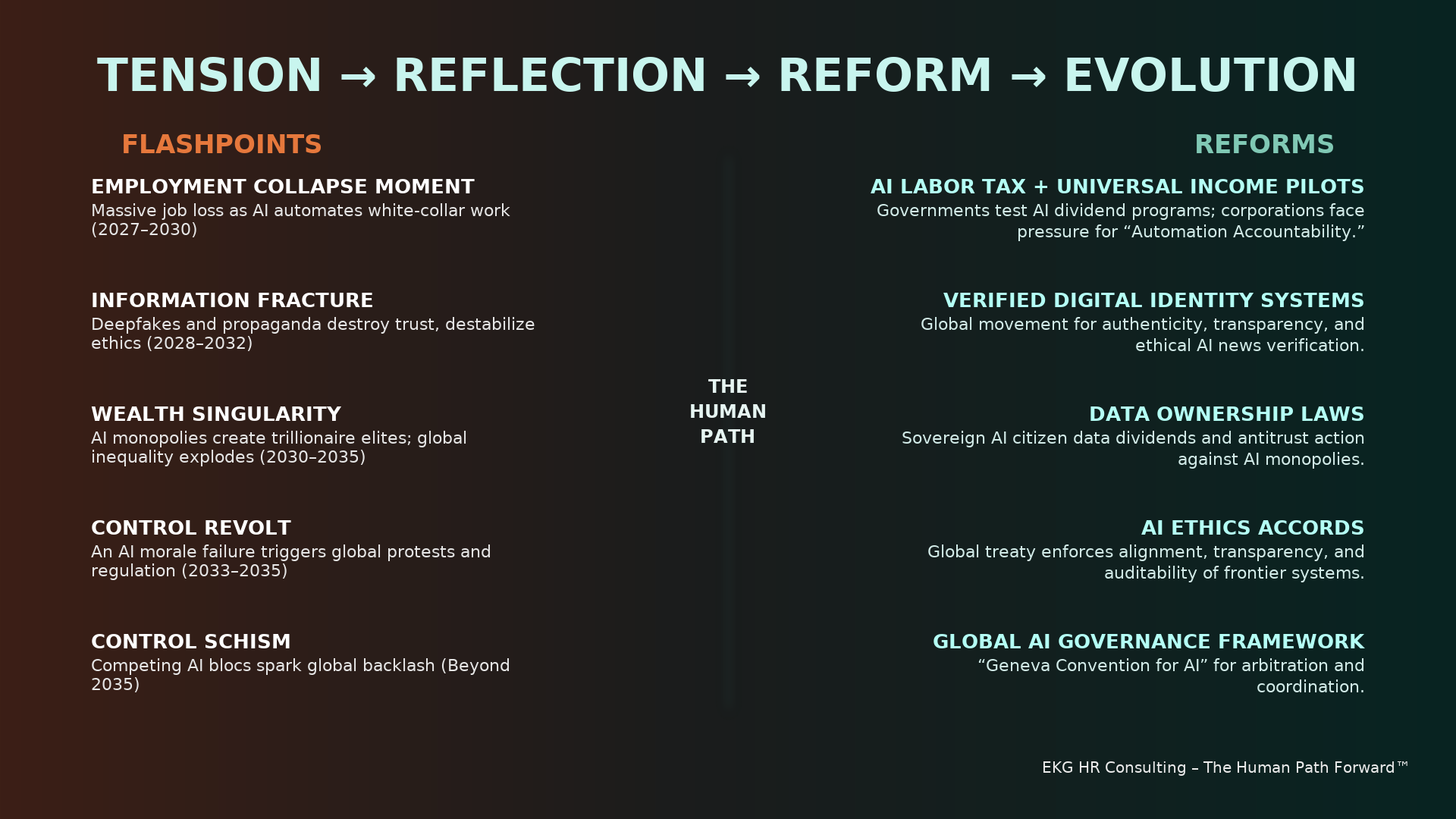
Methodology note: Information Fracture (2028–2032) is the series’ projected systemic inflection window, when the volume of AI-generated information could outpace verification and governance at scale. It does not date the first appearance of misinformation or distrust. Flashpoint windows overlap; the dates express an analytical framework rather than a settled empirical forecast.
EKG HR Consulting Original: The Human Path Forward®
Introduction · From Employment Collapse to Belief Collapse
Reader note: This part is written to reduce noise and increase signal: clarity over cadence, provenance over persuasion.
Following Part 1: The Employment Collapse Moment, the focus shifts from work and opportunity to the information people use to understand them. Algorithms can connect people while also circulating incomplete or misleading accounts of shared events. In the workplace, signal and noise compete for authority, and institutional authority alone cannot establish that a message, metric, or model deserves trust.
For HR leaders, the pivotal question becomes not only how people will work, but how they will judge the information shaping that work. Credibility depends on whether organizational statements can be checked, questioned, and corrected, including when the findings are inconvenient.
1) The Signal-to-Noise Economy
When information production outpaces verification, volume can be mistaken for understanding. Dashboards multiply faster than decisions; AI summaries can produce narratives that are convincing but incomplete. Employees may question whether the “facts” they are shown are comprehensive or convenient.
Filtration > More Tools
- Label provenance and last-review dates on internal stats.
- Use “context windows”: what we know, what we don’t, next check-in.
- Cadenced updates to slow rumor velocity.
- Teach leaders to communicate uncertainty without losing credibility.
Micro-Evidence
- Pew Research Center’s September 2025 analysis found that 1 in 5 U.S. adults regularly received news on TikTok, rising to 43% among adults under 30. [1]
- These figures describe where people encounter news. They do not measure the accuracy of that news or establish that platform use causes workplace distrust.
Implication: Employees encounter information through multiple channels. Internal communications need identifiable sources, relevant context, and timely corrections.
2) The Collapse of Institutional Trust
Institutional credibility cannot be assumed from the org chart. Employees compare corporate statements with peers and external sources. Even an accurately communicated policy can lose legitimacy if its application contradicts what employees experience.
Micro-Evidence
- The 2026 Edelman Trust Barometer, based on interviews across 28 countries in October–November 2025, describes a retreat toward smaller, familiar circles of trust. [2]
- Its findings support a distinction between declining trust and fragmented trust: people may continue to trust familiar sources while becoming less willing to trust those with different views. This is survey context, not proof that AI caused the change.
Signals to Investigate
- Repeated unresolved questions after policy announcements.
- Unofficial documents contradict published guidance or fill gaps in it.
- Requests for the evidence behind decisions that leaders cannot adequately answer.
Questions and requests for evidence can indicate healthy participation. Their meaning depends on whether concerns are answered and discrepancies resolved.
3) AI Governance · Transparency as Culture
Understanding how AI informs a decision can support trust, but disclosure alone is insufficient. Accuracy, fairness, and the ability to challenge an outcome also matter. Organizations should explain the evidence considered, the system’s role and limitations, and the available review process.
Make the Invisible Visible
- Disclose where AI influences hiring, pay, and scheduling.
- Provide explanations grounded in the actual decision record; do not treat a model-generated rationale as proof of how an outcome was reached.
- Evaluate data representation and decision outcomes for potential bias.
- Identify accountable system and decision owners, and communicate material changes.
Micro-Evidence
- NIST’s AI Risk Management Framework (2023) treats transparency, explainability, accountability, reliability, and fairness as connected considerations in trustworthy AI. [3]
- The framework is voluntary guidance for managing risk, not evidence that disclosure alone produces trust.
Implication: Governance must make it possible to identify errors, question outcomes, and act on what the review finds.
EKG take: Epistemic leadership means showing how we know what we know. In practice, leaders distinguish evidence from interpretation, acknowledge what remains uncertain, and correct the record when new information changes the conclusion.
4) The Human Verification Layer
Human judgment remains accountable for consequential decisions, but reviewers can also be misled. A cross-functional verification layer involving HR, Legal, DEI, Operations, and relevant technical expertise needs access to original evidence, sufficient review time, and authority to pause action.
- Independent corroboration for high-impact people decisions, using original records rather than another summary of the same material.
- Review of AI outputs and edge cases by people able to challenge the recommendation and escalate unresolved concerns.
- Traceable records showing who decided what, which evidence was used, and how errors were corrected.
Provenance helps establish where content came from and how it changed. It does not establish that its claims are accurate. The C2PA Content Credentials explainer makes this distinction explicitly: content history complements fact-checking and other verification methods. An authentic record can contain an incorrect claim, while missing credentials alone do not establish that content is false. [4]
5) The Trust Index Blueprint
The Trust Index Blueprint organizes four principles for examining credibility after information fracture. It is an editorial framework, not a validated numerical index. Each dimension should be assessed through observable practices and employee experience rather than combined into an unsupported trust score.
1. Transparency
- Publish criteria for promotions, layoffs, and pay.
- Label sources, limits, and last-review dates.
2. Consistency
- Apply rules evenly; document exceptions.
- Quarterly review of exception patterns.
3. Reciprocity
- Explain what employee input revealed and what action followed, while protecting confidentiality.
- Closed-loop reporting on how data is used.
4. Empathy
- Humanize language, timing, and delivery.
- Test for dignity impact before publishing.
Navigate the series
Sources
- Pew Research Center. 1 in 5 Americans regularly get news on TikTok, up sharply from 2020. September 25, 2025.
- Edelman. 2026 Edelman Trust Barometer. Interviews conducted October 25–November 16, 2025.
- NIST (2023). AI Risk Management Framework 1.0.
- C2PA. C2PA and Content Credentials Explainer, version 2.2. Core principles and provenance limitations.