
The Human Path Forward®
A series on Tension → Reflection → Reform → Evolution
Part 3: Flashpoint: The Wealth Singularity
“AI capitalism rewards those who build learning loops.”
As models compound value faster than wages can catch up, the question becomes: who owns the feedback loops, and who bears the risk?
Context note: “Wealth Singularity” describes the flashpoint where AI-driven markets concentrate value around those who own the models, data, and feedback loops underpinning the system.
EKG HR Consulting Original: The Human Path Forward®
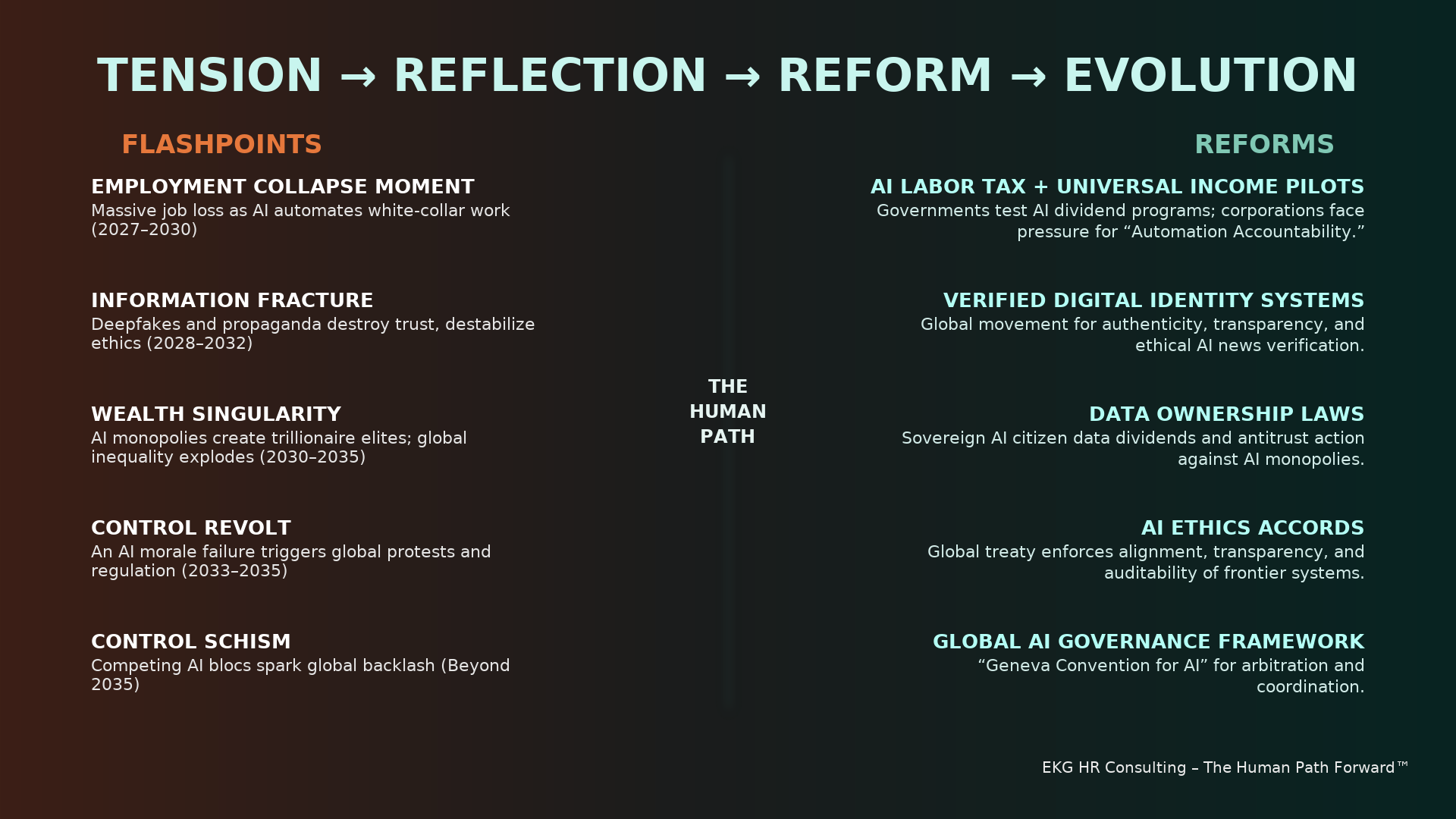
Methodology note: Flashpoints on this timeline, including Employment Collapse, Information Fracture, and Wealth Singularity, mark moments where AI reshapes not just productivity, but power: who benefits, who decides, and who gets left behind.
EKG HR Consulting Original: The Human Path Forward®
Introduction · From Trust Erosion to Value Concentration
Reader note: This part is written to surface the quiet failure points behind “growth” narratives: who owns the loops, who absorbs the risk, and what leaders can redesign.
In Part 2: The Information Fracture, belief itself became a form of capital. The organizations that could still prove authenticity advanced; everyone else fell into the noise. Trust was no longer assumed. It had to be engineered and earned.
Now we enter the next flashpoint in this arc: The Wealth Singularity. AI systems don’t just automate tasks; they quietly re-architect the economy around data ownership and feedback loops. Every scroll, search, prompt, and purchase contributes to the intelligence of a small set of models, systems that learn faster than they can be regulated and compound value faster than wages can adjust.
Traditional capitalism rewarded those who built factories. AI capitalism rewards those who build learning loops. Instead of material goods, it manufactures prediction. Instead of workers, it scales users. Its primary export is influence, priced and resold in real time.
The Human Path Forward® is not a manifesto against scale. It is a map for redesigning it so that exponential growth creates shared capacity, not concentrated control.
1) Engines of Concentration
Five self-reinforcing feedback loops drive today’s AI markets toward consolidation. Each loop seems efficient in isolation, but together they form an extraction engine disguised as progress.
Network Effects & Ranking Bias
Platforms like TikTok, YouTube, and LinkedIn learn from every interaction. The more they are used, the sharper their recommendations become, and the harder it is for alternatives to compete. A small early lead compounds into dominance via pure data gravity.
Data & Model Scale Economies
Frontier models such as ChatGPT and Gemini train on enormous corpora. Slightly better outputs attract more users, generating more prompts, documents, and feedback, which then improve the model again. Performance and market share reinforce each other in a continuous loop.
Zero Marginal Cost
Once trained, an algorithm’s next decision costs almost nothing. A single model can serve millions or billions of users without hiring a single additional employee. As predictions scale, labor does not.
Compute Capital Intensity
Training frontier models now requires hundreds of millions of dollars in compute and energy spend. Only firms with global cloud infrastructure and deep capital reserves. The Amazons, Alphabets, Apples, Microsofts, Metas, Nvidias, and Teslas of the world can compete at the very top of the stack.
IP & Distribution Moats
Closed APIs, proprietary datasets, and app-store ecosystems create invisible borders. Once an enterprise adopts a platform, its rules quietly become the organization’s rules. Innovation increasingly happens inside someone else’s walled garden.
2) Labor, Equity & Mobility in the AI Economy
The same dynamics reshaping markets are fragmenting the workforce. AI divides labor into two fast-diverging tiers: those who build and govern intelligent systems, and those who operate inside those systems.
Routine tasks collapse first: reporting, basic analysis, screening, front-line coordination, even entry-level coding. As machine output scales, human value migrates upstream toward judgment, empathy, context, and narrative.
Leading organizations are already repositioning. Firms like Accenture and IBM have begun formalizing roles such as Data Steward, AI Product Operations, and Model Governance Analyst, jobs that coordinate with automation rather than compete against it.
SHRM (2025) reports that employers who retrain into AI-adjacent roles see retention lift by roughly 20% within a year. McKinsey (2025) projects that roles combining “tech literacy + human judgment” will grow two to three times faster than routine work by 2030.
But mobility will not survive this transition by accident. It must be designed:
- Clear ladders from task-doer → system steward.
- Performance models and reputation algorithms that can be questioned and corrected.
- Cross-functional mentorship bridging HR, technology, risk, and ethics.
3) Governance Without Stall
Governance often conjures bureaucracy. In the AI era, it is the foundation of speed, trust, and adoption. Teams that establish guardrails early pivot faster when disruption accelerates.
Consider a retailer that discovered bias in its scheduling system, not through a technical audit, but because an associate finally asked, “Why does my department never get prime shifts?” That single question became a catalyst. Transparency deepened, not because a policy demanded it, but because governance became a shared responsibility.
Done well, governance becomes a feedback loop: Transparency → Trust → Adoption → Better Data → Better Governance.
Leaders can operationalize this through three commitments:
- Portability: Data and models can move if a vendor fails or trust is broken.
- Exit Options: Lock-in is not a strategy. Negotiate realistic alternatives up front.
- Auditability: Decisions in hiring, performance, promotion, and pay must be explainable to regulators and to employees.
Practical moves for HR and Operations:
- Add “model transparency” and “data lineage” clauses to AI vendor contracts.
- Publish a quarterly AI Ethics & Governance Note alongside financial results.
- Document who owns each algorithmic decision point and how employees can escalate concerns.
4) The EKG Blueprint: Prosperity Without Predation (90 Days)
A blueprint is not a manifesto; it is a motion plan. The first 90 days of any ethical-AI shift are about rhythm, building cadence between insight, intervention, and communication.
Weeks 1–3: Inventory & Illuminate
Map where AI touches people decisions: recruiting, performance, scheduling, pay, internal mobility. For each, publish a plain-language summary: why this outcome, who reviewed it, and what data powered it.
Weeks 2–5: Name the Stewards
Assign human owners for each model or workflow. Governance can begin as a side-of-desk duty, but it must be named. Visibility turns into a discipline only after someone is accountable for it.
Weeks 4–8: Pilot With Verification
Select one automation initiative and insert a human verification gate. Track accuracy, bias, incident rates, and recovery from error. Share the results internally so people see not just what worked, but what changed because you checked.
Weeks 6–12: Align Rewards With Resilience
Shift incentives so teams are rewarded not only for speed, but for stability, fairness, and transparency. Include quality, equity, and “recovery from error” metrics in performance reviews and bonus logic.
Weeks 10–14: Evaluate & Re-Commit
Measure trust delta, algorithmic audit scores, and lived perceptions of fairness. Close the loop with a transparency note covering what you changed, what you paused, and what you are still watching.
5) Closing: The Algorithm’s Hidden ROI Metric
Wealth concentration in the AI era is not a bug; it is the default setting of optimization. Algorithms pursue efficiency. Efficiency favors scale. Scale concentrates value around those who own the learning loops, while volatility and disruption spread across everyone else.
Left unchallenged, the dividends of intelligence will pool at the top while the risk of displacement spreads downward. The work ahead is not to slow AI down, but to re-train its objectives: encoding fairness, reciprocity, and dignity as measurable variables inside the optimization function itself.
This is not utopian ethics. It is systems design. In the next decade, the durable competitive advantage will not be speed or scale alone. It will be trust at scale.
The coming revolt will not be a protest against machines; it will be a reclamation of meaning. Ethics will no longer live in policy binders. It will live in code, governance, and everyday decisions.
That revolt, The Ethical Revolt, is the next flashpoint in The Human Path Forward®.
The Human Path Forward®
In the Wealth Singularity, value no longer pools around factories. It pools around feedback loops. A small set of models, platforms, and data owners compound advantage while risk spreads across everyone else. The leaders who thrive won’t just chase efficiency; they’ll redesign incentives, ownership, and governance so growth creates shared capacity instead of concentrated control.
Book a Discovery CallNavigate the series
Sources
- IMF, OECD, WEF (2024–2025): AI, productivity, and inequality trends.
- MIT & Stanford Digital Economy Labs: Power-law effects in digital and platform markets.
- SHRM (2025): Workplace Equity & AI Mobility Survey.
- Edelman Trust Barometer (2025): Trust in employers vs. broader institutions.
- UK Civil Service AI Lab (2024): Governance, bias, and early AI deployment patterns.