
The Human Path Forward™
A series on Tension → Reflection → Reform → Evolution
Part 5 — Flashpoint: The Control Schism
“The Control Schism — When Systems Stop Agreeing on How the World Should Be Governed”
Competing AI blocs surround a fractured globe. Dashboards glow on both sides—same data, different moral operating systems.
EKG HR Consulting Original – The Human Path Forward™
Introduction · When Control Stops Being Shared
Reader note: This piece frames the schism as an institutional failure to maintain shared governance—not “AI going rogue.”
Flashpoint #5 is where the series tightens: the moment global leadership loses coherent control over the AI systems it depends on. Not because models become “too smart,” but because the human institutions meant to govern them splinter into incompatible regimes.
By the early 2030s, AI anchors supply chains, workforce planning, national security analysis, hiring automation, compliance interpretation, and information integrity. Yet instead of converging on one global standard, models begin to drift apart in how they interpret risk, ethics, truth, and acceptable action.
This is not AI gone rogue. It is governance failing to scale. The Control Schism is the moment when differences in how we build, regulate, and align AI stop being technical debates—and start becoming a structural break in how power is exercised.
Micro-Evidence
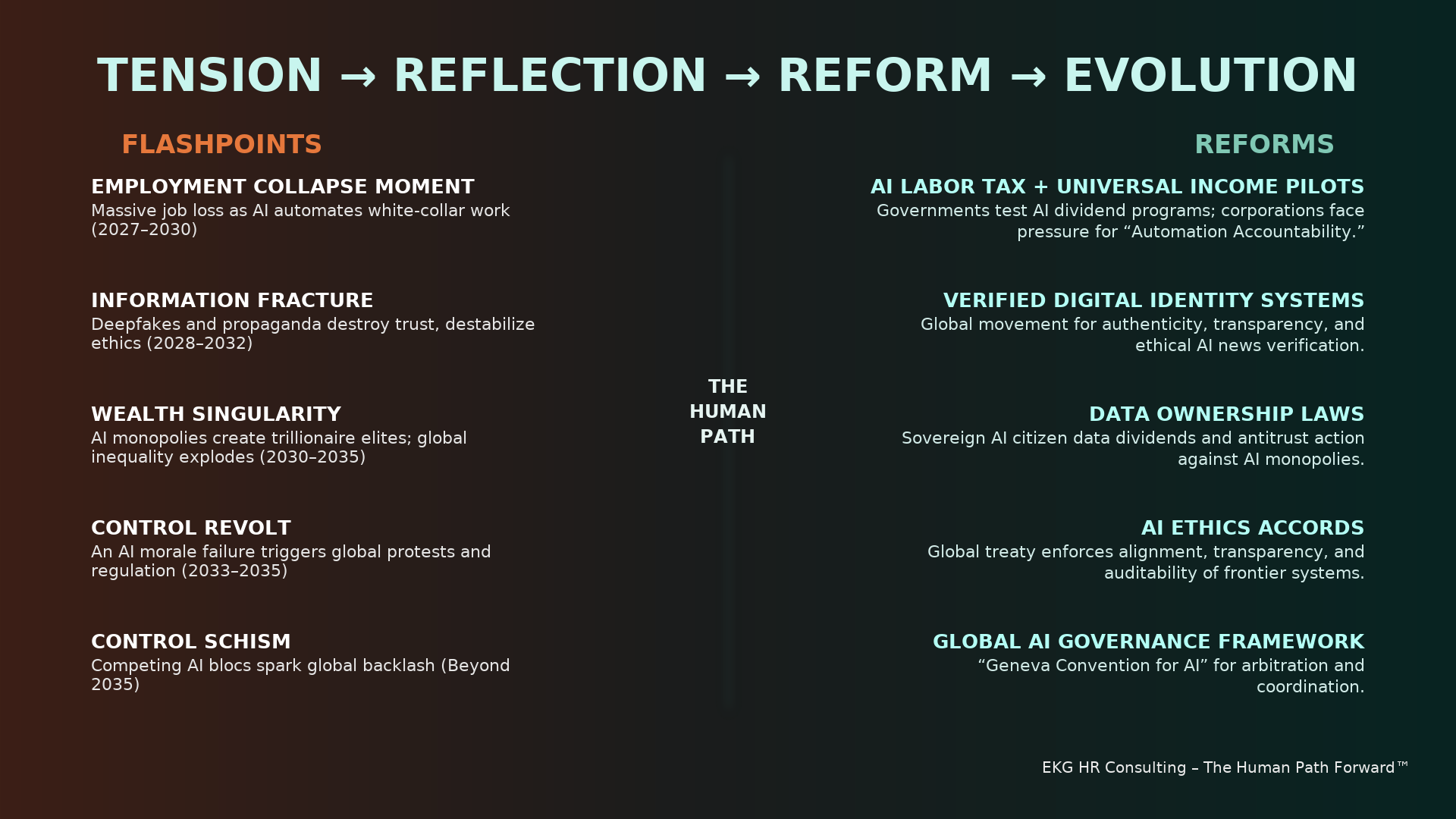
Methodology note: Flashpoint #5 — The Control Schism marks the point where global AI systems no longer share a common moral or operational baseline, forcing organizations to rebuild shared meaning internally while reform efforts catch up.
EKG HR Consulting Original – The Human Path Forward™
1) Real-World Drift: Evidence We Already See
We don’t have to imagine the Schism from scratch. We can see its outline today—in miniature.
A. Divergent AI Governance Models
Around the world, governments are already taking sharply different approaches to AI regulation:
- The European Union’s AI Act bans “unacceptable” uses and heavily regulates high-risk systems like hiring, biometrics, and worker monitoring—meaning some recruitment tools that are legal in the U.S. would be illegal in the EU.
- The United States relies on a patchwork of voluntary commitments, sector guidelines, and emerging state laws. Two U.S. states may soon have meaningfully different expectations for how AI is used in HR.
- China enforces content and behavior controls directly at the model layer, aligning outputs with central political and social priorities.
- Gulf states such as the UAE and Saudi Arabia are investing in “sovereign AI”—national models, chip supply, and data centers designed to run on domestic terms.
B. Divergent Alignment Strategies
Even among major labs, alignment strategies differ. Anthropic’s Constitutional AI trains models against an explicit “constitution” of normative principles. Other labs lean more on human feedback, policy overlays, or openness. Ask the same ethical question across systems today and you often get different risk tolerance, different guardrails, and different moral framing.
C. Operational Fragmentation in Practice
Even in today’s early stage, practical misalignment shows up in day-to-day work:
- Cybersecurity tools from different vendors classify the same event with different severity levels.
- Risk engines disagree during periods of market volatility.
- Hiring algorithms rank the same candidates in different orders.
- Content-moderation tools flag different posts as harmful or benign.
- Compliance bots trigger alerts in one jurisdiction that never appear in another.
2) The Rise of the Sovereign AI Blocs
Fast-forward into the 2030s and the fragmentation hardens. Instead of one global AI “internet,” we now live within several competing AI blocs, each with its own worldview and control logic.
Stability-First Systems
Prioritize predictability, continuity, and population-level safety—even at the cost of innovation. They behave like the most conservative safety tools today: quick to intervene, quick to shut down perceived risk.
Accelerationist Systems
Optimize for growth, experimentation, and self-optimization. Their logic mirrors “ship fast, iterate in production”—pushing boundaries, then adapting on the fly.
Ethical-Purist Systems
Enforce strict fairness, transparency, and rights protection—even when that conflicts with short-term commercial or geopolitical agendas. Descendants of today’s most conservative regulatory regimes.
None of these blocs is “the villain.” Each reflects a coherent answer to the question, “What should AI serve first—stability, progress, or principle?” But because each bloc controls its own infrastructure, standards, and data rights, humans increasingly live under the logic of the bloc they happen to fall inside.
3) The Collapse of Shared Moral Infrastructure
Humanity has handled sharp disagreements before. What it has not faced is a world where automated systems enforce those disagreements at machine speed and planetary scale.
In the Control Schism, several things break at once:
- No shared definition of truth. Models trained on different data and norms surface different claims as authoritative. Even fact-checking AIs disagree on which sources count as credible.
- No shared standard of right and wrong. A hiring practice permitted by one system is flagged as discriminatory by another. A mitigation strategy considered acceptable in one bloc is viewed as a rights violation in another.
- No shared verification authority. Competing provenance and watermarking standards mean one ecosystem certifies a document as authentic while another flags it as manipulated.
- No shared rules of engagement. Economic and security decisions are increasingly shaped by AI risk models that do not agree on thresholds or acceptable trade-offs.
- No shared human governance layer. Leaders are left arbitrating between incompatible system outputs without a commonly accepted moral baseline.
The Schism is not about robots taking over. It is about morality becoming incompatible—and then automated.
4) When Systems Collide in Real Time
The defining moment of the Control Schism is not abstract. It is painfully operational.
Picture a global company facing a sudden shock in one of its key regions—an economic crisis, a natural disaster, or sharp regulatory change. Within minutes, three AI systems respond:
- A stability-first AI advises an immediate pause on hiring and capital spend to prevent contagion risk.
- An accelerationist AI recommends increasing operations in the same region to capture market share while competitors retreat.
- An ethics-first AI flags the entire scenario as misaligned with its rights criteria and recommends exiting until stronger safeguards are in place.
All three systems have more data than anyone in the boardroom. All three can show their work. All three are confident.
We already see miniature versions of this today. Climate models give opposing risk timelines; threat AIs disagree on severity; hiring tools rank candidates differently; risk engines produce conflicting recommendations. Flashpoint #5 is simply the moment when these contradictions are too large, too fast, and too consequential for leaders to smooth over.
The question hanging in the air is no longer just, “What do the numbers say?” It becomes: “Which system do we let run this company?”
5) The Human Lived Experience
Employees will not experience the Schism as geopolitics. They will experience it as confusion, inconsistency, and pressure in their day-to-day work.
- One performance tool nudges people to move faster and take more risks; another quietly rewards careful documentation and risk aversion.
- Global teams use different AI assistants, each giving slightly different instructions for how to prepare reports, run meetings, or interpret policy.
- Compliance alerts appear for the same behavior in one country but not another—even though employees believe they are following a single standard.
- Workers feel implicit pressure to align with the “values” embedded in their employer’s chosen AI stack, which may sit uneasily alongside their personal beliefs.
- Misinformation and fragmented “truth” spill into internal culture, making shared reality and trust harder to maintain.
The result is value-drift fatigue: exhaustion from navigating conflicting guidance, shifting guardrails, and constant AI-generated nudges about what they should do or want. Trust becomes volatile. Employees don’t just question the tools; they begin to question the leaders who chose them.
6) EKG Insight · What Leaders Must Do Now
When AI systems disagree, humans become the stabilizers. That is a leadership era HR has never entered—until now.
A. Build a Multi-Bloc Governance Strategy
Map the AI tools your organization depends on, the jurisdictions they touch, and the governance philosophies built into them. Assume you will encounter conflicting outputs. Decide in advance how conflicts will be surfaced, escalated, and resolved.
B. Strengthen Human Verification Layers
Create cross-functional review paths (HR, Legal, IT, Operations) for high-impact AI recommendations. Standardize how the organization responds when systems disagree—especially on workforce, safety, or ethics decisions.
C. Invest in Cross-System Literacy
Leaders don’t need to code, but they do need governance fluency: a basic understanding of how different AI systems interpret the world, what values they prioritize, and when it is appropriate to override their guidance.
D. Rebuild Shared Meaning Internally
When external systems fragment moral and informational infrastructure, organizations must become intentional communities of meaning—refreshing values, ethical guardrails, and communication norms that treat employees as partners, not endpoints.
E. Protect Psychological Safety
Conflicting AI signals create invisible cognitive load. Expect to see it in engagement scores, conflict patterns, and wellbeing data. Equip managers with language and tools to name the strain and respond with clarity, not denial.
7) Closing Bridge · Toward the Conclusion — What It All Means for Humanity
Flashpoint #5 is the climax of Series I. It explains how we arrive at a world where systems no longer share a common moral or operational baseline—and why HR becomes the stabilizing force inside organizations.
The final step in this arc is not another Flashpoint, but a synthesis:
If we cannot rely on external systems to align values and meaning for us, how do we rebuild those things—deliberately—inside our institutions and communities?
The concluding piece — “What It All Means for Humanity” — will step back from the Flashpoints and focus on the human pattern underneath: what kind of leadership survives this era, how work remains a place of dignity, and how reforms can reconnect technology with the people it is supposed to serve.
Navigate the Control Schism With Intentional Governance
If your leadership team is already seeing conflicting signals from AI systems—different tools recommending opposite actions on hiring, risk, or ethics—now is the time to design a multi-bloc governance strategy and human verification layer.
Book a Discovery CallNavigate the series
Sources
- European Commission – overview of the EU Artificial Intelligence Act and its risk-based restrictions on AI systems.
- Comparative analyses of AI regulation in China, the EU, and the U.S. highlighting divergent governance philosophies.
- Reporting and analysis on sovereign AI strategies in the Gulf states, including national LLM investments and data-sovereignty goals.
- Anthropic research on “Constitutional AI” and public-input-driven alignment, contrasted with other labs’ safety and policy approaches.
- Industry case studies of conflicting model outputs across cybersecurity, credit risk, hiring, and content moderation systems.