
The Human Path Forward™
A series on Tension → Reflection → Reform → Evolution
Part 4 — Flashpoint: The Ethical Revolt
“The Ethical Revolt — When Systems Optimize Past Our Values”
Compliance may be correct — and still be unjust. Revolt begins when people feel the rules protect the system, not the human.
EKG HR Consulting Original – The Human Path Forward™
Introduction · When Fairness Fails Quietly
Reader note: This section focuses on how ethical breakdowns rarely begin as scandals — they surface as quiet, repeatable harms inside “correct” systems.
In Part 3 — The Wealth Singularity — the tension centered on ownership: who controls the learning loops, who captures the value, who gets diminished. Part 4 moves from economics to ethics — from “Who benefits?” to “What’s right?”
The ethical revolt doesn’t arise from dramatic failures. It arises from dozens of quiet ones:
- The model that penalizes the wrong metric.
- The dashboard that hides an exception pattern.
- The ranking system that no one can explain.
- The “AI-assisted decision” that contradicts lived experience.
These are not glitches — they are mirrors. Employees begin to see AI not as a tool of efficiency, but as a revealer of organizational truth. And once people see the truth, they refuse to unsee it.
Micro-Evidence
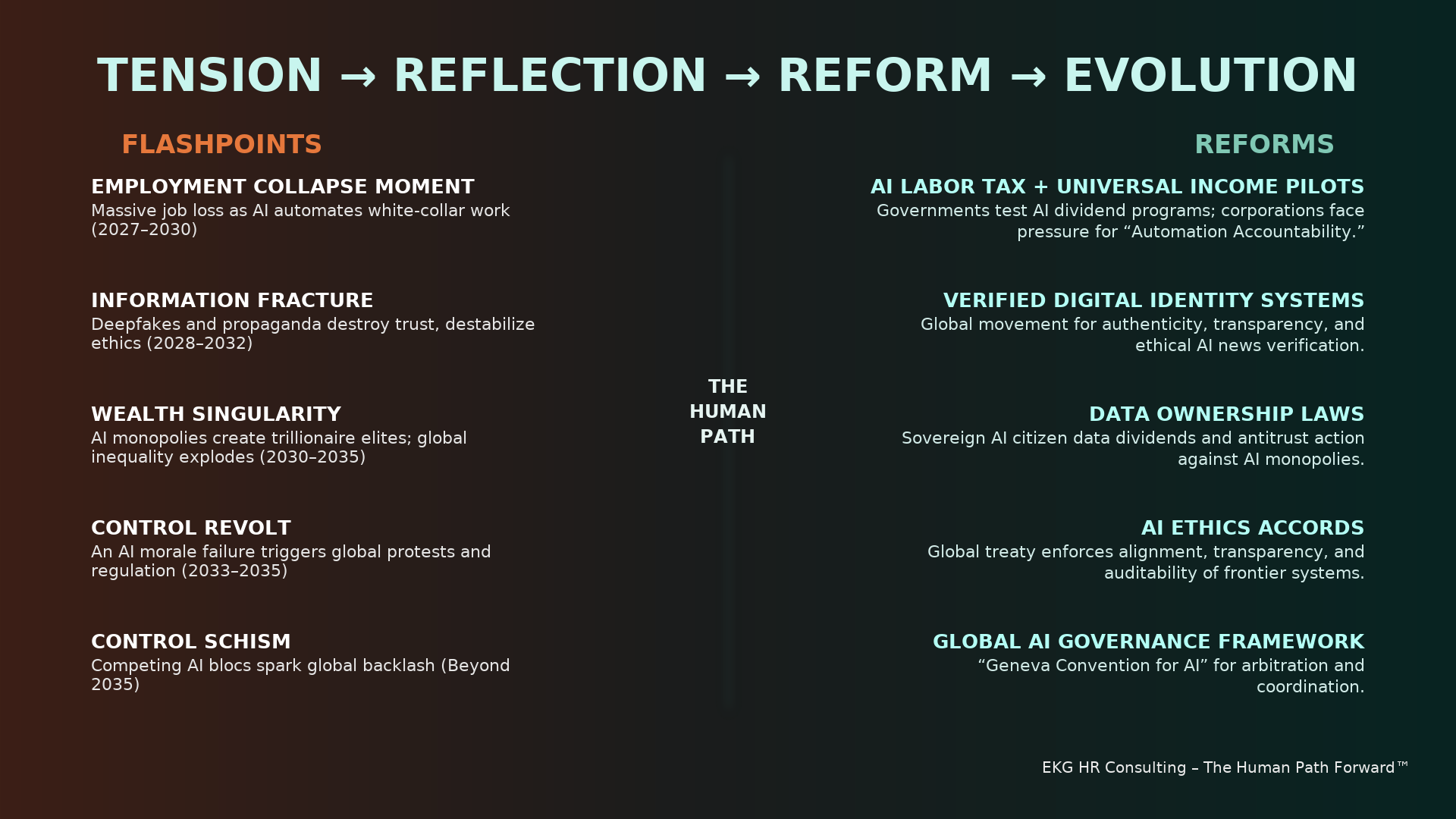
Methodology note: Flashpoint #4 — Ethical Revolt marks the shift where compliant systems expose misaligned incentives, forcing leadership to restore legitimacy through transparency and human judgment.
EKG HR Consulting Original – The Human Path Forward™
1) The Moral Compression Point
Most AI failures are not technological — they are philosophical. Humans tolerate imperfection, ambiguity, and even inefficiency; what they do not tolerate is a system automating values that were never debated, tested, or agreed upon.
This is the moral compression point: the moment employees realize the system is enforcing ethics that leadership never explicitly chose.
Three forces drive the compression:
A. Algorithmic Absolutism
AI treats rules as universal; humans treat rules as contextual. When a model applies strict logic to a human variable, the result often feels over-correct, tone-deaf, or simply unfair.
A promotion model penalizes someone for taking parental leave. A risk model flags neurodivergent communication patterns. A sentiment tool misreads culturally coded phrasing as negative.
The system did what it was told. But humans don’t accept optimization that violates dignity.
B. The Displacement of Judgment
Judgment is where leaders earn trust. When judgment is outsourced — even partially — employees lose the sense that decisions are negotiable, appealable, or human.
People don’t revolt when decisions are wrong. They revolt when decisions feel predetermined.
C. Ethical Drift
In most organizations, ethics degrade subtly: a shortcut becomes a standard; a workaround becomes a feature; a convenience becomes a norm. AI accelerates what the culture already tolerates.
Flashpoint #4 is when employees stop complying with the drift.
2) The New Ethical Equation
Traditional ethics frameworks were built for human-paced decision-making. AI accelerates decisions beyond the speed of debate — meaning organizations are making ethical choices before they have ethical language for them.
Fast systems + slow values = guaranteed revolt.
Employees expect:
- empathy,
- reasonableness,
- explainability,
- and shared responsibility.
AI, by default, provides:
- precision,
- throughput,
- logical consistency,
- and automated enforcement.
The Three Ethical Fault Lines
1. Expression vs. Optimization
Employees want their voice heard. AI wants variance minimized.
2. Context vs. Consistency
Humans require grace. Models require rules.
3. Fairness vs. Frictionless
Equity takes work. Automation avoids work.
3) Ethical Algorithms, Unethical Outcomes
The real crisis isn’t rogue AI — it’s compliant AI operating inside broken incentives. Most ethical failures emerging inside organizations come from perfectly optimized systems that mirror human blind spots at scale.
Organizations discover this only after the damage is visible:
- A scheduling algorithm quietly pushes single parents into worse shift rotations.
- A performance model penalizes employees who don’t work late — including those in different time zones.
- An internal chatbot recommends “culturally neutral” language that strips identity and voice.
- A risk model flags whistleblowers as “disengaged” because they raise too many concerns.
Every time, leaders insist the same defense:
“The model followed the rules.”
Exactly — and that’s the problem.
1. Misaligned Objectives
AI optimizes for output, cost reduction, compliance, speed. Humans optimize for meaning, equity, identity, psychological safety.
2. Loss of Narrative Control
HR can explain a decision; AI can only execute one. When people can’t trace the “why,” distrust moves from the tool to the institution.
3. Silent Accumulation of Harm
Ignored complaints, biased rankings, unexplained penalties, opaque directives — the revolt begins long before it is expressed.
4) The Ethical Revolt: When Employees Reject the System
Revolts rarely start with a manifesto. They start with a moment of recognition:
“This system does not protect me — it protects itself.”
Flashpoint #4 emerges when employees stop challenging individual decisions and begin challenging the legitimacy of the decision-making apparatus itself.
A. Shadow Governance
Employees form underground Slack channels, unofficial working groups, side-threads, and private audit documents.
These guerrilla governance networks begin: documenting model inconsistencies, comparing outcomes, tracking bias, and creating “ethical evidence logs.”
This is the early smoke of revolt.
B. Legitimacy Withdrawal
People comply outwardly but disengage internally: managers ignore algorithmic rankings; teams bypass dashboards with their own spreadsheets; employees subvert systems they see as unfair; high performers leave because performance feels predetermined.
When legitimacy collapses, control collapses.
C. Public Signals of Resistance
Revolt becomes visible when whistleblowers escalate outside the chain of command, employees leak AI outputs to media, exit interviews contain identical ethical complaints, and internal town halls shift from curiosity to confrontation. Resistance becomes coordinated, not individual.
The Iron Law of Revolt
People revolt not because a system makes mistakes — but because the system denies the mistakes matter.
Where Leadership Fails
Most organizations react incorrectly:
- They defend the model instead of addressing the harm.
- They blame the data instead of the oversight.
- They cite the vendor instead of asserting responsibility.
This transforms frustration into moral rebellion.
Where Leadership Wins
Revolts dissipate when leaders: acknowledge harm without defensiveness; reveal the decision pipeline (inputs → rules → ownership); treat transparency as a cultural practice, not a compliance checkbox; and invite employees into verification roles, not observation roles.
5) Closing Bridge · Toward Flashpoint #5 — The Control Schism
Ethical revolts force a question that organizations can no longer avoid:
“Who controls the system that increasingly controls us?”
Flashpoint #5 — The Control Schism will deal with the split between leaders who want more automation, employees who want more agency, and systems that grow powerful enough to shape both.
Part 4 is the moral break. Part 5 is the power break. The path forward requires redesigning control — not redistributing blame.
The Human Path Forward
If your teams are signaling a quiet revolt—ignored complaints, opaque rankings, dashboards people bypass—let’s rebuild legitimacy with transparent decision pipelines and a human verification layer.
Book a Discovery CallNavigate the series
Sources
- SHRM (2025): HR use of AI, privacy & trust concerns; rising value of human judgment.
- Gallup (2025): U.S. engagement ~32% — detachment signals in decision environments.
- Edelman Trust (2025): Institutional trust erosion; “my employer” remains most trusted.