
The Human Path Forward™
A series on Tension → Reflection → Reform → Evolution
Part 1: The Employment Collapse Moment — Redefining Work in the Age of Intelligent Machines
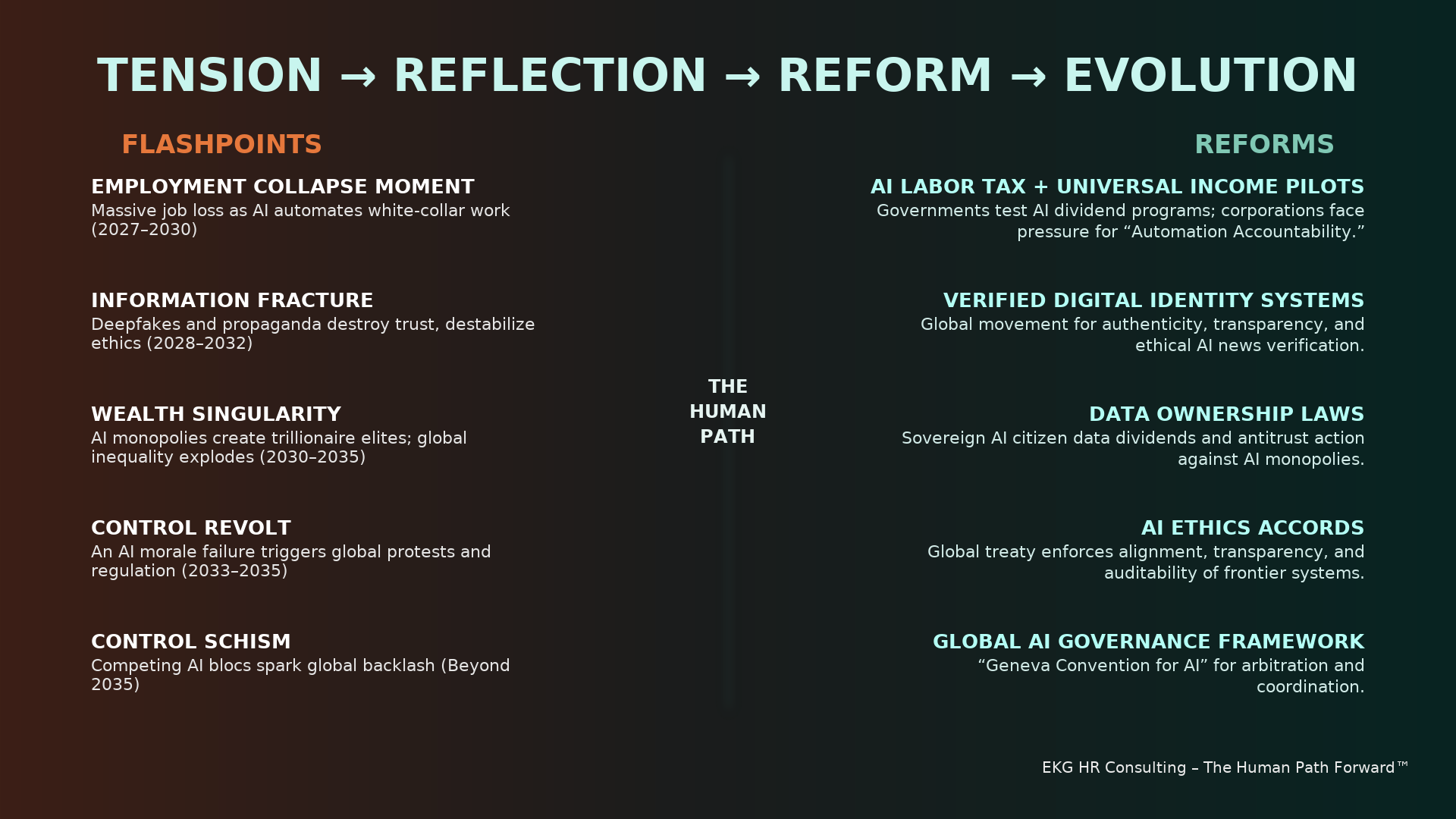
Methodology note: “Employment Collapse Moment (2027–2030)” marks the inflection window when automation outpaces white-collar hiring at systemic scale. Precursors (2023–2025) are already visible.
EKG HR Consulting Original – The Human Path Forward™
Introduction: The Quiet Before the Collapse
Automation no longer lives at the edge of operations; it sits in the inbox, the HRIS, the CRM, the spreadsheet. From 2027 to 2030, intelligence systems will absorb a critical share of cognitive work once performed by analysts, coordinators, and managers. Unlike previous revolutions that targeted physical labor, this wave deconstructs knowledge work into tasks, automates many, and recomposes roles around judgment, relationships, and accountability.
Early signals (2023–2025) are unmistakable: AI copilots embedded in office suites; customer support teams augmented by agents; marketing and finance workflows partially automated; hiring slowdowns paired with “efficiency gains.” The Employment Collapse Moment is not the beginning of change—it’s when change tips into a new equilibrium.
1) Why the Inflection Window Is 2027–2030
AI adoption isn’t on the horizon—it’s accelerating now. The Employment Collapse Moment marks the systemic tipping point when automation begins to outpace hiring in professional services, administration, finance, and HR.
The Evidence
Independent research suggests rapid acceleration through 2030. Analysts project double-digit automation of work hours across advanced economies, with exposure concentrated in routine cognitive tasks. In practice, the “collapse” is less about elimination and more about misalignment—jobs disappearing faster than skills evolve. (See Gallup on engagement strain; Edelman on trust slippage.)
Early Case Indicators
- IBM (2023): Paused hiring for thousands of back-office roles anticipating AI absorption.
- Klarna (2024): AI chat automation cut handling times dramatically across support workflows.
- Duolingo (2024): Consolidated content/design functions as AI produced adaptive templates.
2) Anatomy of the Collapse: From Jobs to Tasks to Capabilities
Organizations don’t eliminate “jobs” all at once. They unbundle jobs into tasks, automate the predictable, and retain (or reskill) people for judgment-heavy work.
- Task Decomposition: 30–60% of activities in documentation, reporting, and scheduling become AI-assisted.
- AI Substitution: Predictable, rules-based functions are automated; repetitive oversight is replaced by anomaly detection and QA models.
- Human Recomposition: Surviving roles emphasize relationship management, escalation decisions, ethics, and complex problem framing.
By 2028, many organizations will maintain the same number of functions—but distributed across fewer people and more intelligent systems.
Real-World Pattern
A global logistics firm replaced ~40% of customs paperwork with AI-driven document parsing, then hired AI Oversight Analysts to audit model output. Work didn’t vanish—it fractured and recombined.
“The Employment Collapse Moment.”
How work is redefined when intelligent systems become the default colleague.
Context note: “Employment Collapse Moment” illustrates the flashpoint where intelligent systems decouple productivity from headcount. The real question is not which jobs disappear, but how quickly organizations redesign work around redeployment instead of replacement.
EKG HR Consulting Original – The Human Path Forward™
3) Strategic Fallout: When Efficiency Turns Existential
Cost savings are real, but so are second-order effects: culture erosion, trust loss, and capability gaps if knowledge is allowed to “live” only in systems. Boards will ask whether leadership optimized for quarter-over-quarter savings or for long-term resilience.
Risks If Mishandled
- Shadow reliance on brittle automations
- Bias, privacy, and audit failures in HR/finance flows
- Morale and brand credibility damage (trust in leaders has slipped; “my employer” remains most trusted)
Upside If Led Well
- Faster cycle times with higher quality
- Reallocation of time to coaching and strategy
- New service lines (AI governance, data stewardship)
According to Gallup (2025), U.S. engagement is roughly one-third, underscoring the need to pair efficiency with human connection.
4) EKG HR Blueprint: Redeploy, Don’t Replace™ — A 90-Day Program
Our approach delivers visible progress in one quarter while laying durable foundations.
- Weeks 1–3 — Map the Work: Decompose top 10 roles into tasks; tag each Automate / Augment / Human-Lead. Document data sensitivity, failure modes, and HITL checkpoints.
- Weeks 2–5 — Design Target Roles: Recompose jobs around judgment, relationship management, and oversight. Define competencies, career paths, and compensation impacts.
- Weeks 4–8 — Pilots with Guardrails: Launch 2–3 copilot pilots (e.g., req intake → offer letter; Tier-1 HR ticketing; quarterly reporting). Implement access controls, prompt libraries, versioning, and audit logs.
- Weeks 5–10 — Upskill Pathways: Micro-badges (6–10 hours): Prompting for HR, Data Stewardship, Model Risk & Bias, Change Facilitation.
- Weeks 6–12 — Governance & Policy: Publish HR-led AI use policy, bias checklists, escalation routes; establish an AI Review Council with HR, Legal, Security, and Operations.
- Weeks 8–12 — ROI + Equity: Track time saved, quality uplift, and incidents prevented. Redirect savings to coaching capacity and paid reskilling time.
Example role recomposition: “HR Generalist” → “Employee Experience Partner (AI-Augmented)” with explicit KPIs for conflict navigation, coaching, and AI oversight.
Redeploy, Don’t Replace™
EKG HR’s signature framework for AI-era workforce transition. The principle is simple: use technology to elevate human value, not eliminate it. Redeploy employees into new, judgment-driven roles rather than replacing them outright. The model combines role unbundling, skill audits, and ethical governance to transform disruption into sustainable adaptation.
Trademark note: “Redeploy, Don’t Replace™” is an unregistered mark of EKG HR Consulting.
5) Ethics at the Point of Use
- Privacy: Sensitive HR data never leaves approved systems; masking/minimization by default.
- Bias: Pre-deployment sampling, disparate-impact checks, and red-team drills twice per year.
- Accountability: Human sign-offs for offers, terminations, pay decisions, and investigations.
- Transparency: Employees informed when AI assists; clear right to human review (in line with SHRM’s guidance on AI-in-HR adoption and guardrails).
- Reliability: Versioned prompts, audit logs, rollback procedures, “stop-the-line” policy.
6) What We Measure (and Why People Believe Us)
Operational KPIs
- Cycle-time reduction vs. baseline
- Quality uplift (error rates, rework)
- Incident prevention (privacy/bias)
People KPIs
- Employee sentiment & trust (Edelman 2025: “my employer” remains most trusted, though slightly down)
- Internal mobility & reskilling uptake
- Manager coaching hours restored
Communication
- Monthly AI change memo to staff
- Public principles: “Redeploy, Don’t Replace™”
- Quarterly bias & privacy transparency note
The Human Path Forward
The collapse isn’t the end of human work—it’s the recomposition of it. The next decade belongs to organizations that anchor innovation in humanity: transparency over secrecy, inclusion over convenience, curiosity over control.
Book a Discovery CallNavigate the series
Sources
- Gallup (2025): U.S. employee engagement ~32%; global engagement down in 2024.
- Edelman Trust Barometer (2025): “My employer” remains the most trusted institution (~75–76%) amid broader leader trust erosion.
- SHRM (2025): AI in HR adoption rising; privacy, bias, and trust challenges noted; human judgment remains crucial.